|
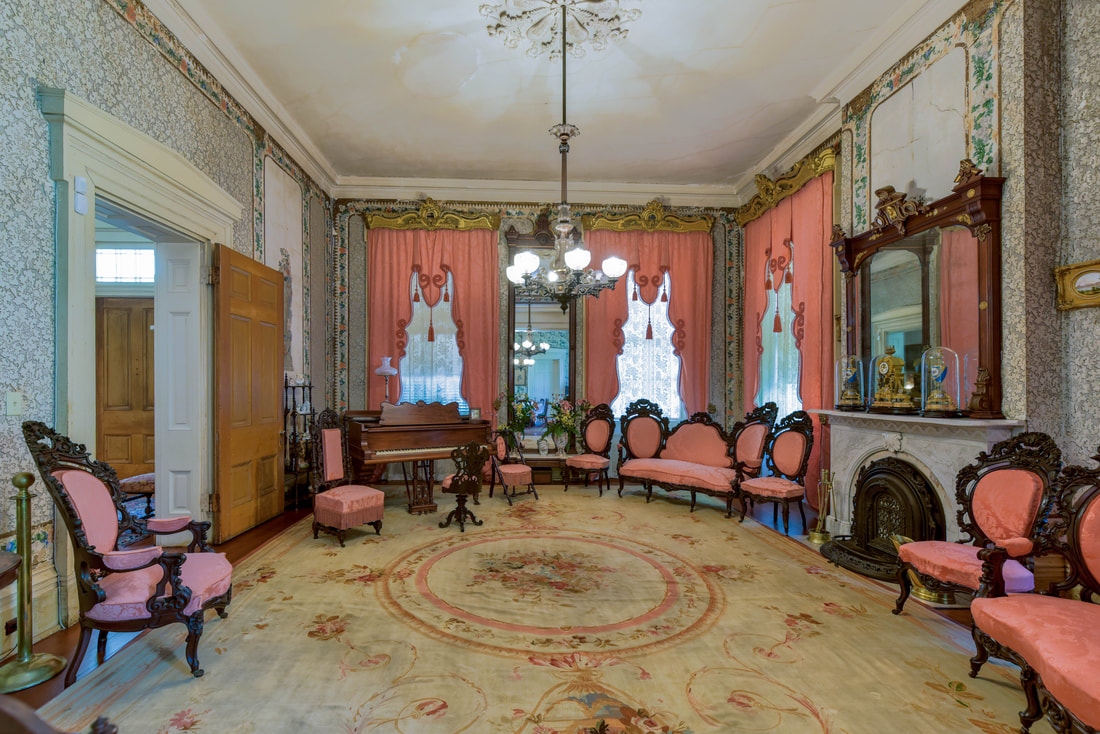
The Parlor
One of the finest remaining examples of Rococo Revival, the room remains almost unchanged since the house was built. The Zuber wallpaper is the original dating from 1853. The furniture is hand carved rosewood from France. Mantels throughout the house are white Carrara and black Egyptian marble. The marbleized cypress baseboards are hand painted to match the mantels. The bronze gasoliers throughout the house were made by Cornelius and Baker in Philadelphia. Lansdowne had its own coal-fired illuminating gas plant. The house was wired for electricity in the late 1930's. |
Dining Room
Double sliding doors connect the parlor and the dining room. The dining room is presided over by portraits of the builder, George M. Marshall, painted by Louis Bahin, and his father Levin R. Marshall, painted by Thomas Sully. The dining room collection includes original Old Paris china and family silver hidden by the butler during the Civil War and saved from Union soldiers who broke in and ransacked the house in 1865.
Double sliding doors connect the parlor and the dining room. The dining room is presided over by portraits of the builder, George M. Marshall, painted by Louis Bahin, and his father Levin R. Marshall, painted by Thomas Sully. The dining room collection includes original Old Paris china and family silver hidden by the butler during the Civil War and saved from Union soldiers who broke in and ransacked the house in 1865.
The Hall
The hall is sixty-five feet long and has ceilings fourteen feet high. Family portraits and other artwork line the walls of the hall which is used today as a family living room. The original faux bois or false grained cypress doors and baseboards were hand painted to resemble golden oak. Six rooms including the parlor, dining room, butler’s pantry and three bedrooms all open into the hall.
The hall is sixty-five feet long and has ceilings fourteen feet high. Family portraits and other artwork line the walls of the hall which is used today as a family living room. The original faux bois or false grained cypress doors and baseboards were hand painted to resemble golden oak. Six rooms including the parlor, dining room, butler’s pantry and three bedrooms all open into the hall.
|
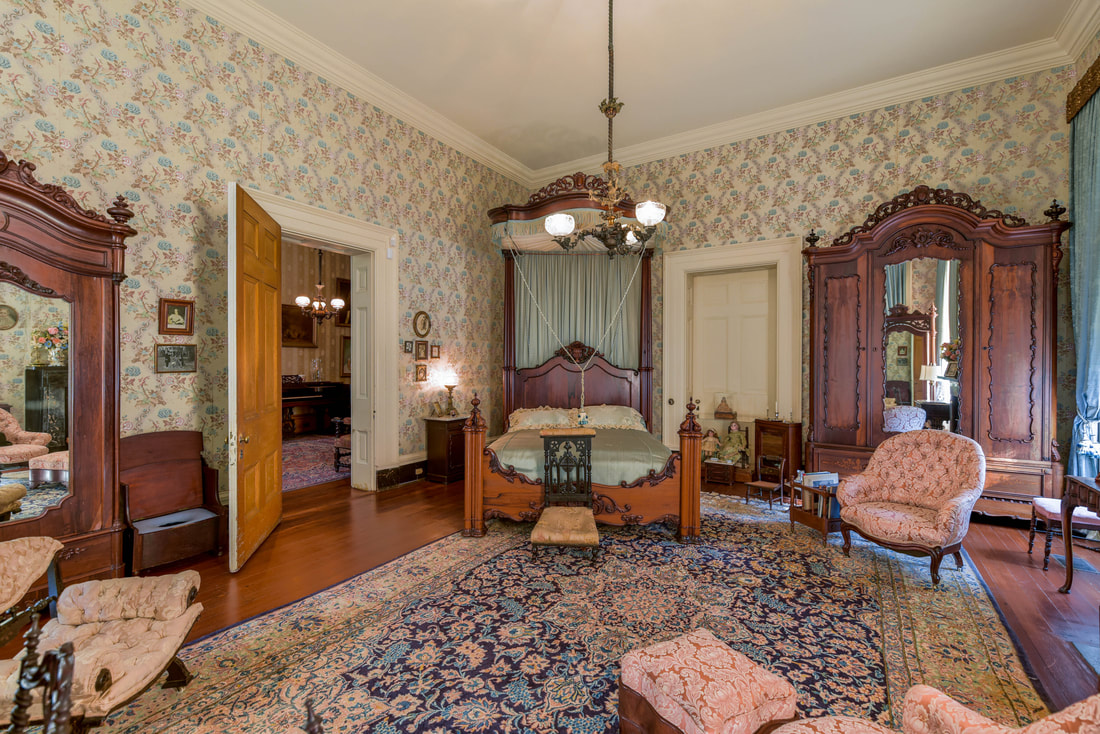
Front Bedroom
The front bedroom was originally the master bedroom and features rosewood furniture purchased from Mallard of New Orleans. The large half tester bed retains the brass rods for mosquito netting which was pulled forward to surround the bed at night and draped over posts at the foot of the bed which extend upward telescopically. The front bedroom and parlor have jib doors beneath the windows which can be opened providing access to the front gallery. |
|
Middle Bedroom
This room was originally intended to be a library. However, the family became impatient to finish the house and decided to make it a one story house instead of two story, hoping to add the second story later. Thus some of the downstairs rooms had to be converted to bedrooms. This room features a mahogany “clover leaf” bed made in New Orleans by Seigneuret.
This room was originally intended to be a library. However, the family became impatient to finish the house and decided to make it a one story house instead of two story, hoping to add the second story later. Thus some of the downstairs rooms had to be converted to bedrooms. This room features a mahogany “clover leaf” bed made in New Orleans by Seigneuret.
|
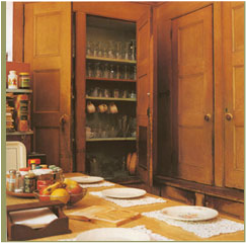
Butler's Pantry
Food was cooked in the kitchen which was separate from the main house, and was then brought into the Butler’s Pantry for serving into the adjacent dining room. The Pantry has the original false grained cypress cabinets and has been converted into a kitchen. |